Swelling After A Hair Transplant: Why It Happens And How To Reduce It
Last reviewed on 12 August 2026. We review our treatment guides every six months to keep them accurate.
Key points
Swelling of the forehead, and sometimes around the eyes, in the first few days after a hair transplant is normal, common and almost always harmless. It is one of the most frequent things people notice while healing.
It is very common. A 2026 review of transplant complications found forehead swelling "in nearly half of patients, making it the most common early postoperative finding", with swelling around the eyes in a smaller share.
It follows a predictable pattern: it usually appears on day one or two, peaks around days two to three, can slide down to the eyelids by gravity, and settles on its own within about five to seven days.
It happens because of the fluid used during surgery. The local anaesthetic and tumescent fluid injected into the scalp gradually drains downward to the forehead and eyes, along with a little normal inflammation.
It is not a complication and does not harm the grafts. As a second review puts it, swelling "is not a complication per se, but more of a surgical consequence", and it does not affect graft survival or the result.
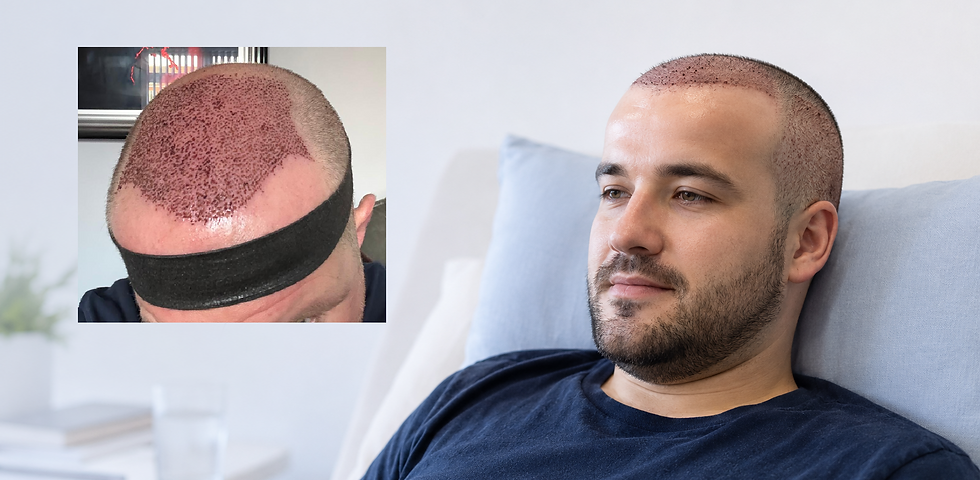
You can reduce it: sleeping propped up, cold compresses to the forehead (never the grafts), and following your clinic's advice, which may include a forehead band or a short course of tablets to limit it.
Occasionally swelling needs checking, if it is severe, one-sided with pain and redness, comes with a fever, or is not settling after about a week. Otherwise it is simply part of healing.
Looking in the mirror two or three days after a hair transplant and finding a swollen forehead, or puffy, half-closed eyes, is one of the most alarming parts of the recovery, and one of the most misunderstood. It looks dramatic, but in almost every case it is a normal, expected and completely harmless stage of healing that passes within a week. Knowing why it happens and what helps takes the worry out of it.
This guide explains why swelling happens after a transplant, what pattern to expect, how long it lasts, how to reduce it, whether it affects the result, and the uncommon signs that mean you should call your clinic. It is general information and does not replace your own surgeon's aftercare advice, which always comes first.
Is swelling after a hair transplant normal?
Yes, very. Forehead swelling is the single most common thing people experience in the early days after a transplant. The 2026 complications review describes it plainly: "edema", the medical word for swelling, "is a common but generally minor postoperative event following FUE", and "frontal edema has been observed in nearly half of patients, making it the most common early postoperative finding, while periorbital swelling", swelling around the eyes, "occurs in approximately 3 to 5 per cent".
So swelling of the forehead is close to expected rather than a sign that something has gone wrong, and swelling that reaches the eyes, while more striking, is much less common and still benign. Either way, the review is clear that it causes only "temporary cosmetic or functional discomfort" and is "benign and self-limited".
Why does swelling happen?
It is mostly about fluid and gravity rather than anything going wrong. During the transplant, a large volume of local anaesthetic and tumescent fluid, a dilute solution used to numb the scalp, protect the follicles and make the skin firm to work on, is injected into the scalp. Over the next day or two, that fluid does not simply disappear; it gradually drains downward under gravity from the top of the head to the lowest nearby area, which is the forehead, and from there sometimes to the eyelids and around the eyes.
The complications review sets out the mechanism as "infiltration of tumescent anesthesia and gravitational fluid shift toward the periorbital region, together with local inflammatory changes and transient lymphatic disruption". The second review lists the same contributors, "large amount of tumescence, gravity pull downward, lymphatic drainage of frontal scalp, loose donor skin, elderly patients, and mega sessions". In plain terms: the more fluid used and the larger the session, the more swelling there tends to be, which is why bigger transplants and dense work across the frontal scalp are more likely to swell.
This is also why the swelling is nearly always across the forehead and eyes rather than at the recipient area itself, and why it is a downward, spreading pattern over the first few days rather than something centred on the new hair.
What should I expect, and how long does it last?
The pattern is predictable, which is reassuring in itself. Swelling typically begins on the first or second day after surgery, builds to a peak around days two to three, and then eases and disappears on its own. The review gives the timeline as "peaking around 2 to 3 days after surgery and resolving spontaneously within 5 to 7 days"; the other review puts the usual span at three to five days. Either way, within roughly a week it is gone.
During the peak, it is common for the forehead to feel tight and look puffy, and for one or both eyes to become puffy or even temporarily half-closed as the fluid reaches them, sometimes with mild bruising. This can look worrying and is not flattering, but it is not painful as a rule, it does not damage anything, and it resolves completely. It helps to expect it, to plan for a few quiet days at home around the peak if you can, and to remember it is fluid passing through, not a problem with the transplant.
How can I reduce swelling after a hair transplant?
You cannot always prevent it entirely, but a few simple measures genuinely limit how much swelling you get and how long it lasts. Your clinic's own instructions come first, but the measures the reviews and the literature support are:
Keep your head elevated. Sleeping propped up at roughly 20 to 30 degrees, or semi-upright in a recliner, for the first few nights uses gravity in your favour and is one of the most effective steps. Our guide on how to sleep after a transplant explains the positioning.
Use cold compresses, but not on the grafts. A cold pack held against the forehead and above the eyebrows in the first day or two helps, but it must be kept away from the transplanted (recipient) area, which should not be pressed, iced or touched while the grafts are settling. Follow your clinic on timing.
Wear the headband, if you are given one. A compression band worn across the forehead, just below the hairline, keeps the swelling isolated to the forehead and stops fluid sliding down under gravity into the eyelids, where it can make the eyes feel heavy. Our surgeons provide a headband, which not every clinic does, whenever swelling towards the front hairline is expected, and recommend wearing it for about five to six days after surgery. It is generally only needed for work at the front: for a transplant to the crown alone, a headband is not usually necessary, because swelling towards the back of the head is normally reabsorbed by the body without tracking down into the face.
Take the tablets your clinic prescribes. To reduce inflammation and swelling, our clinic provides a short course of an oral steroid, prednisolone, after surgery, along with lansoprazole to protect the stomach from any irritation while taking it. Some clinics instead, or as well, add a steroid to the anaesthetic during surgery; the review notes that adding a steroid to the tumescent fluid cut swelling from around 40 per cent to 9 per cent in one study. Whatever you are given, take it exactly as directed; our guide on medication after a transplant explains what you may be prescribed.
Avoid bending, straining and lying flat. Bending forward, heavy lifting and lying completely flat all encourage fluid to pool in the forehead, so keeping upright and taking it easy for the first few days helps.
Gentle forehead massage, if advised. Some clinics suggest lightly massaging the forehead downward toward the temples to help the fluid move on. Only do this if your clinic has recommended it, and never near the grafts.
None of these are essential to a good outcome, since the swelling settles on its own regardless, but together they make the peak milder and shorter.
Does swelling affect the transplant result?
No. This is the most important reassurance, and both reviews are clear on it. The complications review states that swelling "is not a complication per se, but more of a surgical consequence" and that it "does not compromise graft survival or outcomes". The other review likewise classes it as benign and self-limited. The swelling is fluid in the forehead and eyelids; it is not in the recipient area where the grafts are, and it has no bearing on how well the transplanted hairs take or grow.
It is also worth separating swelling from the other normal early changes, so none of them alarms you: some redness in the recipient area, a crop of small spots or folliculitis, and the shedding of the transplanted hairs a few weeks later are all separate, expected parts of healing, and like swelling, none of them means the transplant is failing.
When should I contact my clinic?
Ordinary swelling needs only patience and the measures above. It is worth contacting your clinic if the swelling is severe or rapidly worsening, if it is clearly one-sided and comes with pain, spreading redness or heat, if you develop a fever or feel unwell, if an eye is painful rather than just puffy, or if the swelling has not started to settle after about a week. These are uncommon, but they are the situations where swelling might reflect an infection or another problem that needs looking at rather than simple post-operative fluid. As always, your clinic would far rather you sent a photo or called than waited and worried, and in the great majority of cases the answer will be reassurance.
Where does this leave swelling after a transplant?
For almost everyone, swelling after a hair transplant is a normal, temporary and harmless part of healing rather than a sign of anything wrong. It is the most common early finding, it comes from the fluid used during surgery draining down under gravity, it peaks around days two to three and clears within about a week, and it has no effect on the grafts or the final result. Sleeping propped up, using cold compresses on the forehead but never the grafts, and following your clinic's advice on bands or tablets all make it milder and shorter.
If you are recovering from a transplant and unsure whether your swelling is normal, the simplest reassurance is to send a photo to the clinic that treated you, who know your surgery and can confirm you are healing as expected.
Frequently asked questions
Is swelling normal after a hair transplant?
Yes, and it is very common. Forehead swelling is the most frequent early finding after a transplant, seen in around half of patients in one review, and swelling around the eyes happens in a smaller share. It comes from the fluid used during surgery draining downward and is benign and self-limiting, so a swollen, puffy forehead in the first few days is expected rather than a sign that something has gone wrong.
How long does swelling last after a hair transplant?
Usually about a week. Swelling typically appears on the first or second day, peaks around days two to three, and resolves on its own within roughly five to seven days, with some sources giving three to five days. It may slide down to the eyes at its peak before settling. If it has not started to improve after about a week, it is worth checking with your clinic.
Why are my eyes swollen after a hair transplant?
Because the fluid causing the forehead swelling drains further down under gravity and collects around the eyes, which are the next lowest point. Swelling that reaches the eyelids can make them puffy or temporarily half-closed, sometimes with mild bruising. It looks dramatic but is harmless and passes within a few days. Sleeping propped up and cold compresses on the forehead help limit it.
How do I reduce swelling after a hair transplant?
Keep your head elevated, especially sleeping propped up at around 20 to 30 degrees for the first few nights; use cold compresses on the forehead but never on the transplanted area; avoid bending, straining and lying flat; and follow any advice from your clinic, such as wearing a forehead band or taking a short course of tablets. These measures make the swelling milder and shorter, though it settles on its own in any case.
Does swelling mean my hair transplant has failed?
No. Swelling is fluid in the forehead and eyelids, not in the area where the grafts are, and both major reviews confirm it does not affect graft survival or the result. It is a normal surgical consequence rather than a complication. Swelling, redness, small spots and the later shedding of the transplanted hairs are all separate, expected parts of healing, and none of them means the transplant is failing.
Get back to Great Hair
in 3 Easy Steps:
01
Arrange Free Consultation
Speak to one of our specialist consultants for expert advice on our range of different hair loss treatments
02
Book Your Procedure
Place a deposit to reserve a time slot at one of the My Hair UK clinics across the UK
03
Attend Your Surgery
Arrive on the day and our specialist surgical team will look after your every need


What People Say About Us
Read our independent My Hair UK Reviews on Reviews.io
The Surgical Team
The surgical team is what makes the difference on the day. The clinics’ five surgeons are all GMC-registered, with a minimum of 1,000 FUE hair transplant procedures each to their name. Between them the team handles complex cases, including Afro-textured and women’s hair transplants, hairline design and lowering, and revision work.


Manchester clinic
• Dr Khawaja Masood Munir: GMC 6122581.
8+ years’ experience, 1,400+ hair transplant surgeries.
• Dr Haider Gillani: GMC 8030796.
1,000+ procedures, with specific expertise in complex cases requiring detailed anatomical understanding.
London (Harrow) clinic
• Dr Mahdi Alosert: GMC 6168297.
20+ years’ clinical experience. Specialist in Afro-Caribbean hair and hairline lowering.
• Dr Shuaib Mir: GMC 7567898.
1,200+ hair transplant cases. BAAPS plastic surgery and RCS anatomy training.
• Dr Zakar Rafiq: GMC 6164032.
MBBS and BSc (Hons) from Imperial College London. Associate Member of the International Society of Hair Restoration Surgery (ISHRS).
You can meet the surgeon who will perform your procedure at your free consultation.