PRF For Hair Loss: How It Works And What The Evidence Shows
Last reviewed on 1 August 2026. We review our treatment guides every six months to keep them accurate.
Key points
PRF stands for platelet-rich fibrin. It is made from a sample of your own blood, spun in a centrifuge to concentrate the platelets, then injected back into the scalp to try to stimulate the hair follicles.
It is often described as a "second-generation" version of PRP. The key difference is that no anticoagulant is added and the blood is spun more gently, so it forms a soft fibrin scaffold that is thought to release its growth factors more slowly and for longer.
The form used for hair is injectable PRF, sometimes written i-PRF. Classic PRF is a firm gel used in dentistry and surgery and cannot be injected.
The real-world data for hair is genuinely limited. A 2024 systematic review found only a handful of small studies, and across the three that looked specifically at pattern hair loss, just 22 patients in total, about 73 per cent showed a noticeable improvement. None of those studies had a comparison group.
That puts PRF a clear step behind PRP on evidence, not ahead of it. PRP now has several randomised trials and a meta-analysis of 10 of them showing a measurable gain in hair density, whereas PRF's theoretical advantage has never been proven to beat PRP in a head-to-head trial.
Because it uses your own blood with nothing added, the safety picture so far is good, with injection-site pain, swelling and bruising being the usual complaints.
It is a procedure rather than a licensed medicine, it is not available on the NHS for hair loss, and it is not a substitute for the treatments with the strongest evidence.
Platelet-rich fibrin, or PRF, is one of the newer injectable treatments offered for thinning hair, and it is usually presented as an upgrade on the better-known PRP. The idea is appealing and the biology behind it is reasonable, but the evidence for hair loss specifically is still thin, and the way PRF is marketed can make it sound more established than it is.
This guide explains what PRF actually is, how it differs from PRP, how it is supposed to work, what the studies genuinely show, and its safety and status in the UK, so you can weigh it up properly rather than from a clinic's treatment menu. Because it involves drawing and reinjecting blood, anyone considering it should discuss it with a doctor first.
What is PRF (platelet-rich fibrin)?
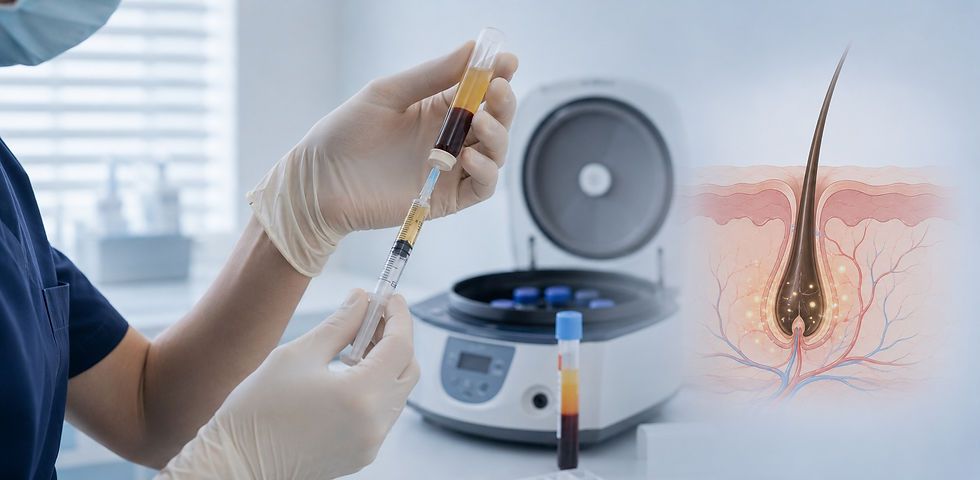
PRF is an autologous treatment, meaning it is made from your own body. A small amount of blood is taken from your arm, much as it would be for a routine blood test, and placed in a centrifuge that spins it to separate out and concentrate the platelets and white cells. That concentrate is then injected into the scalp.
Platelets are best known for helping blood to clot, but they are also packed with growth factors, the signalling proteins the body uses to trigger repair and regeneration. The whole premise of both PRF and PRP is to deliver a concentrated dose of those growth factors to struggling hair follicles.
It helps to know that these preparations are grouped into families. As a 2017 review in Skin Appendage Disorders sets out, platelet concentrates are classified by whether they contain white cells and by the density of the fibrin they form. Classic PRF, developed by Choukroun, sets into a firm fibrin gel and is used in dentistry and oral and facial surgery; that solid form cannot be injected. The version used for hair loss is a liquid known as injectable PRF, or i-PRF, produced by spinning the blood at a very low speed so it stays fluid long enough to draw up and inject.
How is PRF different from PRP?
PRF uses no anticoagulant and a gentler, slower spin, forming a soft fibrin scaffold thought to release growth factors more slowly than PRP.
PRF and PRP are close relatives, and both concentrate platelets from your own blood, but two differences in how they are prepared are the whole reason PRF exists.
The first is the anticoagulant. To make PRP, an anticoagulant is added to the blood so it stays liquid while it is spun and injected. PRF is made without any anticoagulant, so the blood begins to clot naturally and the platelets become caught in a mesh of fibrin, the protein that forms the structure of a clot.
The second is the spin. PRF uses a single, slower, gentler centrifugation rather than the faster spin used for PRP. The result is that soft fibrin scaffold with the platelets and white cells held inside it. Supporters argue this matters because, rather than releasing everything at once as liquid PRP does, the fibrin matrix is thought to act as a reservoir that lets the growth factors out gradually over a longer period. Whether that theoretical difference produces a better result for hair is the crucial question, and it is examined below.
How is PRF supposed to work for hair loss?
The rationale is the same as for PRP, with one added twist. The concentrated platelets release growth factors such as platelet-derived growth factor (PDGF), transforming growth factor beta (TGF-beta) and vascular endothelial growth factor (VEGF). In the scalp these are thought to stimulate activity in the hair follicles and encourage the growth of small blood vessels around them, improving the follicle's blood and nutrient supply. The systematic review describes PRF as being hypothesised to "stimulate hair follicles and improve hair density" through exactly this kind of growth-factor and angiogenic effect.
The added twist, and the entire marketing case for PRF over PRP, is timing. Because the growth factors are held within the fibrin scaffold rather than floating free in a liquid, the theory is that they are released more slowly and over a longer period, giving what one description calls a more sustained effect than the rapid, short-lived burst from PRP. The absence of an anticoagulant is also presented as making PRF a more "natural" preparation.
It is important to be clear about what this is: a plausible biological rationale, not a proven clinical advantage. A treatment can release its growth factors more slowly in a laboratory dish and still make no measurable difference to how much hair a person keeps or regrows. The value of the idea has to be judged on what happens in actual patients, which is where the evidence, and its limits, come in.
Does PRF work for hair loss?
The honest position is that the early results are encouraging but the evidence is very limited, and it is much weaker than the evidence for PRP.
The most useful overview is a systematic review published in Cureus in 2024 by Mohale and colleagues, which gathered every study it could find on injectable PRF for hair loss and facial rejuvenation. For alopecia it identified only three studies looking specifically at pattern hair loss, covering 22 patients between them, and reported that around 73 per cent of those patients showed a clinically noticeable improvement in hair growth or density. The authors concluded that "injectable PRF therapy shows promise in treating androgenetic alopecia" and describe it as having "potential as an effective treatment option in regenerative dermatology". That is a genuinely positive signal and it deserves to be stated plainly.
The same review is candid that the treatment is "well-tolerated with minimal reported side effects", which is reassuring, but it is equally candid about how far from settled the evidence is.
How good is that evidence?
Not yet good enough to rely on, for three specific reasons that the review itself sets out.
The studies are tiny. Three studies and 22 patients is a very small foundation. Findings from groups this small can easily be down to chance, and cannot be assumed to hold across the wider population of people with hair loss.
There were no control groups. The hair-loss studies did not compare PRF against a placebo or an untreated area, so there is no way to be sure the improvement was caused by the PRF rather than by other things the patients were doing, natural variation, or the simple expectation of benefit. The review lists small sample sizes, a lack of control groups, short follow-up and limited generalisability as its main limitations.
PRP is the more established of the two, not less. This is the point the marketing tends to invert. Whereas PRF for hair rests on a few uncontrolled studies, PRP has been through many randomised controlled trials. A meta-analysis of 10 of those trials, covering 318 people, found that PRP produced a statistically significant increase in hair density of about 25 hairs per square centimetre compared with a control. Even PRP is not regarded as a proven, first-line treatment, so a newer relative with far less data sits a clear step further back, however advanced "second-generation" is made to sound.
Put together, PRF is a promising idea with a reasonable biological rationale and an encouraging early safety record, but for hair loss it remains an experimental option awaiting the larger, controlled trials, and ideally the direct head-to-head comparisons against PRP, that would show whether its theoretical advantage is real. Other injectable and needle-based treatments at a similar early stage are covered in our guides on PRP injections, exosome therapy, mesotherapy and microneedling.
Is PRF better than PRP?
On current evidence, there is no good reason to say so. The case for PRF being better rests entirely on the theory that its fibrin scaffold releases growth factors more slowly, and that idea has not been tested against PRP in the kind of head-to-head trial for hair loss that would be needed to prove it. What can be said is that PRP has the larger and better-quality body of evidence of the two, and is the more established option.
PRF does have one genuine practical difference in its favour: because no anticoagulant is added, it is a slightly simpler preparation using only your own blood with nothing else introduced. Whether that translates into any real-world benefit for your hair, rather than just a tidier description, is exactly what the missing trials would have to show.
Is PRF safe?
The early safety picture is good, and this is one of PRF's real strengths. Because it is made entirely from your own blood, with no anticoagulant or other additive, the risk of an allergic or immune reaction is very low. The systematic review found PRF to be "well-tolerated with minimal reported side effects".
That does not mean it is risk-free. Any injection into the scalp can cause pain, swelling, bruising, redness or tenderness at the injection sites, which are usually short-lived, and any procedure that breaks the skin carries a small risk of infection, which is why sterile technique and a properly trained practitioner matter. Drawing blood can also cause light-headedness or bruising at the arm. People with certain blood disorders, those on blood-thinning medication, or those with active scalp infections may not be suitable, which is one reason a proper medical assessment beforehand is important.
It is also worth remembering that a good safety record is not the same as proven effectiveness. PRF being gentle and well-tolerated is a point in its favour, but it does not answer the separate question of whether it actually works.
Is PRF for hair loss available on the NHS or licensed in the UK?
PRF for hair loss is not available on the NHS. It is offered privately, usually in aesthetic and hair clinics, and typically as a course of several sessions followed by occasional maintenance, so the cost adds up over time.
Unlike a tablet or a cream, PRF is not a licensed medicine, because nothing is manufactured or dispensed: it is a procedure that processes and reinjects your own blood during the same appointment. That means it does not carry the licence, patient information leaflet or standardised safety monitoring that a licensed medicine does, and there is no official approval specifically endorsing it as an effective hair-loss treatment. UK doctors and clinics may offer it, but the responsibility for judging that it is appropriate rests with the practitioner, which makes their training and honesty about the evidence all the more important.
What to ask before having PRF
If you are considering it, these questions cut through the marketing:
Is this injectable PRF (i-PRF) specifically, and what evidence is there for my particular type and pattern of hair loss, rather than for PRF or platelet treatments in general?
How does it compare with PRP, which has a larger evidence base, and why are you recommending PRF over it?
How many sessions will I need, at what total cost, and what happens if I see no benefit?
Who performs the injections, what is their medical training, and how is sterility ensured?
Have the treatments with the strongest evidence, and if appropriate a hair transplant assessment, been considered first?
For pattern hair loss in particular, the treatments with the most evidence behind them remain the medical mainstays and, where suitable, a hair transplant. PRF may have a place as an add-on to discuss with a knowledgeable doctor, but it is not a replacement for them.
Where does this leave PRF?
PRF for hair loss is a legitimate and low-risk idea with a sensible biological rationale, but it is early-stage. Its safety record so far is reassuring, and the small studies that exist are positive, but they are few, tiny and uncontrolled, and the theoretical advantage over PRP that gives PRF its selling point has never been proven in a proper comparison. Marketed as "second-generation", it is in evidence terms the less established of the two.
Anyone weighing up a hair transplant or another scalp treatment should discuss PRF with their own surgeon or doctor first, since injections can affect the timing of other treatment and aftercare. Your clinic can advise on what it offers, and whether it is worth considering in your particular case.
Frequently asked questions
Does PRF regrow hair?
The early evidence is encouraging but very limited. A 2024 systematic review found only three small studies of PRF for pattern hair loss, covering 22 patients in total, with about 73 per cent showing a noticeable improvement, but none had a comparison group. So PRF shows promise and appears to help some people, but it has not been proven to the standard of the established treatments, and the data is weaker than for PRP.
Is PRF better than PRP for hair loss?
There is no good evidence that it is. The argument for PRF is a theory, that its fibrin scaffold releases growth factors more slowly, which has never been tested against PRP in a head-to-head trial for hair loss. In fact PRP has the larger and better-quality evidence base of the two, including several randomised trials, so it is the more established option despite PRF being marketed as the newer, upgraded version.
Is PRF safe?
The early safety picture is good. Because PRF uses only your own blood with no additives, the risk of an allergic reaction is very low, and studies describe it as well-tolerated. The usual side effects are pain, swelling, bruising and redness at the injection sites, which are generally short-lived, plus the small infection risk that comes with any injection, so a trained practitioner and sterile technique matter. A good safety record is not the same as proven effectiveness, however.
How many PRF sessions are needed?
There is no standard course, and protocols vary between clinics, but PRF is generally given as a series of sessions spaced a few weeks apart, followed by occasional maintenance treatments. Because it is a repeated procedure rather than a one-off, the time and cost build up over the year, which is worth factoring in when comparing it against other options.
Is PRF available on the NHS?
No. PRF for hair loss is not offered on the NHS and is a private treatment. It is a procedure using your own blood rather than a licensed medicine, so it does not carry the official approval or safety monitoring that a licensed medicine does, and it is offered at the discretion of the clinic providing it.
Get back to Great Hair
in 3 Easy Steps:
01
Arrange Free Consultation
Speak to one of our specialist consultants for expert advice on our range of different hair loss treatments
02
Book Your Procedure
Place a deposit to reserve a time slot at one of the My Hair UK clinics across the UK
03
Attend Your Surgery
Arrive on the day and our specialist surgical team will look after your every need

