How Many Grafts Do I Need For A Hair Transplant?
Last reviewed on 27 July 2026. We review our treatment guides every six months to keep them accurate.
Key points
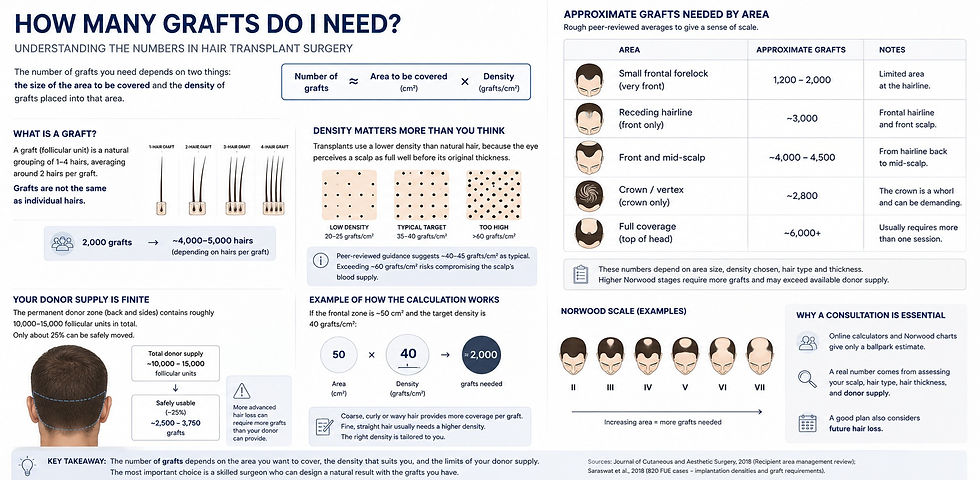
There is no single number. How many grafts you need is worked out from two things: the size of the area to be covered, and the density of grafts placed into it.
A graft, or follicular unit, is a natural cluster of one to four hairs, so grafts are not the same as hairs. A 2,000-graft procedure moves roughly 4,000 to 5,000 hairs.
Transplants deliberately use a lower density than your original hair, because the eye reads a scalp as full well before its original thickness. Many surgeons aim for around 35 to 40 grafts per square centimetre in the visible frontal zones, and less towards the crown, adjusting for hair type and thickness.
As a rough peer-reviewed guide, restoring a frontal hairline area takes on the order of 3,000 grafts, the front and mid-scalp together around 4,000 to 4,500, and full coverage of the top of the head around 6,000 or more.
Your donor area is finite. The permanent donor zone holds roughly 10,000 to 15,000 follicular units in total, but only about a quarter can be safely moved, so more advanced hair loss can need more grafts than the donor can supply.
More is not always better. Packing grafts too densely can outstrip the scalp's blood supply and, rarely, cause skin necrosis in which the grafts are lost and a scar is left, which is why a sensible target density is a safeguard, not a limitation.
A calculator or a Norwood chart can only ever give a ballpark. The real number comes from an in-person assessment of your scalp, hair and donor supply, and it should also allow for future hair loss.
"How many grafts do I need?" is usually the first question people ask about a hair transplant, and it is the hardest to answer from a distance, because the honest answer is that it depends on you. But it is not a mystery, and it is not a number a clinic should simply pluck out of the air. It is a calculation, and understanding how it is done lets you judge whether a quote you have been given is realistic.
This guide explains what a graft actually is, how the number you need is worked out, roughly how many different degrees of hair loss take, and the single most important constraint on all of it: your donor supply. It is general information and not a substitute for an in-person assessment, which is the only way to get an accurate figure.
What is a graft, and is it the same as a hair?
No, and the difference matters when you compare quotes. A graft is a follicular unit, the natural grouping in which hair grows, and each unit contains between one and four hairs, averaging around two. So the number of grafts is always lower than the number of hairs moved. A 2,000-graft procedure transplants roughly 4,000 to 5,000 hairs, depending on how many hairs each unit happens to contain.
This is worth knowing because some clinics, particularly abroad, quote in hairs or use the words loosely, which can make one quote look very different from another for the same actual procedure. When comparing, make sure you are comparing grafts with grafts.
How is the number of grafts worked out?
It comes down to a simple sum: the number of grafts is roughly the area to be covered, in square centimetres, multiplied by the density of grafts placed into each square centimetre. A surgeon measures the balding area and chooses an appropriate density, and the two together give the number.
The density is the part most people do not expect. Your scalp's original hair grows at a high density, but a transplant does not try to match it, because it does not need to. The eye perceives a scalp as full at well below its original density, so packing in more grafts than necessary wastes precious donor hair and, past a point, risks the blood supply the grafts depend on. A 2018 review of recipient site management in the Journal of Cutaneous and Aesthetic Surgery puts a central density of around 40 to 45 grafts per square centimetre as typical and warns that exceeding about 60 risks compromising the scalp's blood supply.
In practice many surgeons aim a little more conservatively, for around 35 to 40 grafts per square centimetre in the high-visibility frontal zones, tailing off to a lower density towards the crown. That is consistent with a peer-reviewed series of 820 FUE cases, which used an implantation density of 30 to 40 follicular units per square centimetre at the front, reducing to 20 to 25 towards the vertex. Crucially, the right density is not fixed; it is adjusted for your hair type and thickness, because coarse, curly or wavy hair gives far more visual coverage per graft than fine, straight hair, so the same natural-looking result can need fewer grafts.
To make that concrete: a frontal zone measuring roughly 50 square centimetres, filled at 40 grafts per square centimetre, works out at about 2,000 grafts. Double the area, or aim for a fuller look, and the number rises accordingly. That is the whole calculation, and it is why the area you want covered drives the figure far more than any Norwood number on its own.
Can you have too many grafts, or too high a density?
Yes, and this is the serious reason surgeons do not simply pack in as many grafts as possible. The grafts depend on the scalp's blood supply to survive, and cramming too many into too small an area can outstrip that supply.
In the worst case this causes skin necrosis: the tissue in the over-packed area loses its blood supply, dies, and the grafts placed there are lost, which can leave a permanent scar rather than hair. A 2026 review of FUE complications describes recipient-site necrosis as "a rare but potentially severe complication" that causes "partial or complete tissue loss at the implantation site, potentially leading to graft failure and scarring", and lists dense packing, above roughly 50 grafts per square centimetre, and very large sessions of more than about 3,500 to 4,000 grafts among its technical risk factors, with the mid-scalp most vulnerable because its blood supply is relatively poorer. Smoking, diabetes and other conditions that impair circulation add to the risk, which is one reason those are asked about before surgery.
It is a rare complication, not something to be frightened of, but it is exactly why a sensible target density, the sort of 35 to 40 per square centimetre many surgeons work to, is not a limitation but a safeguard. Chasing the highest possible number, or the densest possible packing, trades a marginal and often invisible gain in fullness for a real increase in the risk of losing grafts altogether. More is not better past the point the blood supply can support.
How many grafts for different amounts of hair loss?
As a rough guide, a frontal hairline takes about 3,000 grafts, the front and mid-scalp 4,000 to 4,500, and full coverage 6,000 or more.
With the calculation in mind, the following are broad, peer-reviewed averages for how many grafts different amounts of coverage tend to take. Treat them as a sense of scale, not a quote. They come from the same published series of 820 cases and are approximate:
A small frontal forelock, a patch at the very front: on the order of 1,200 to 2,000 grafts.
A receding frontal hairline and the front of the scalp: roughly 3,000 grafts.
The front and mid-scalp together: around 4,000 to 4,500 grafts.
The crown or vertex on its own: around 2,800 grafts, though the crown is a whorl and can be a hungry area.
Full coverage of the top of the head: around 6,000 grafts or more, usually across more than one session.
The higher your Norwood stage, the larger the area and so the more grafts are needed, and the most advanced patterns can call for more than the scalp can safely provide. This is why the number is really a question about how much area you want to cover and to what density, rather than a single figure attached to a diagram.
Why a consultation, not a calculator?
Online graft calculators and Norwood charts are everywhere, and they are fine for a rough idea, but they cannot give you your number, because they cannot measure the things that decide it. Two people at the same Norwood stage can need very different amounts.
An in-person assessment looks at the actual size of the area to be covered, the density and calibre of your existing hair, how much your hair colour contrasts with your scalp (less contrast looks fuller for fewer grafts), and, most importantly, how much healthy donor hair you have to work with. A good assessment also considers your age and how your hair loss is likely to progress, so that today's procedure does not use up hair you will need later. A number quoted without seeing your scalp is a guess, however confident it sounds.
The real limit: your donor supply
Everything above runs into one hard constraint, and it is the most important thing to understand about graft numbers: the hair used for a transplant is not unlimited. It comes from the permanent zone at the back and sides of the scalp, and once it is used, it is gone.
The published FUE series puts the average permanent donor zone at roughly 10,000 to 15,000 follicular units in total. But you cannot harvest all of them, because taking too many leaves the donor area visibly thin. Following the common rule of removing no more than about one in four, that yields on the order of 2,500 to 3,500 grafts from the scalp in a session while keeping the donor area looking natural. Where scalp supply is limited, the same study describes supplementing it with beard hair, which yielded around 1,100 grafts per case, and body hair, around 1,500, though these are a separate decision to discuss with a surgeon.
This finite supply is why graft numbers are not simply "as many as it takes". For advanced hair loss, the area that could be covered may exceed what the donor can safely give, and the surgeon's job becomes prioritising, usually the frontal third and hairline that frame the face, rather than chasing full coverage and exhausting the donor. Our guide on the donor area explains this in more depth, and the guide on increasing density covers what can and cannot be added later.
It is also why a responsible surgeon plans for the long term rather than the maximum today. A younger patient who uses most of their donor supply on an aggressive hairline can be left short years later as their loss advances, which is a poor trade. Preserving reserve is part of doing it well.
Where the area is too large for one session, or the donor needs to be used sparingly, the work is staged across more than one procedure. When a second session is needed, surgeons generally recommend leaving a minimum of about six months between operations. That gap lets the scalp heal fully and lets the transplanted hair begin to grow, so the next session can be planned around the result you actually have rather than guessed at, and so the donor area has recovered before more is taken.
The bottom line
How many grafts you need is your bald area multiplied by a sensible density, usually around 35 to 40 grafts per square centimetre at the front and less behind, adjusted for your hair type and capped by how much donor hair you can safely spare. As a sense of scale, a frontal restoration is on the order of 3,000 grafts and full coverage of the top around 6,000 or more, but your real number can only come from an assessment of your scalp, and a good one plans for the future as well as the present. If you are considering surgery, that assessment with a qualified surgeon is the right next step, not a calculator.
Frequently asked questions
How many grafts do I actually need?
It depends on the area you want covered and the density used. As a rough sense of scale from peer-reviewed data, a frontal hairline restoration is on the order of 3,000 grafts, the front and mid-scalp together around 4,000 to 4,500, and full coverage of the top around 6,000 or more. Your own number depends on your scalp size, hair type and donor supply, and can only be determined by an in-person assessment.
Is a graft the same as a hair?
No. A graft is a follicular unit, a natural cluster of one to four hairs, averaging about two. So a 2,000-graft procedure moves roughly 4,000 to 5,000 hairs. Some clinics quote in hairs or use the terms loosely, so when comparing quotes, check you are comparing grafts with grafts.
How many grafts can you have in one session?
The limit is set by your donor area, not an arbitrary number. Removing no more than about one in four follicular units keeps the donor area looking natural, which for an average scalp gives on the order of 2,500 to 3,500 grafts from the scalp per session. Larger "mega sessions" are possible in the right hands, but the donor supply, not ambition, sets the ceiling.
Do more grafts always look better?
No. Beyond the density needed to look full, extra grafts add little visible benefit and waste finite donor hair. Packed too tightly they can also outstrip the scalp's blood supply, which in rare cases causes skin necrosis, where the over-packed tissue dies and the grafts there are lost, leaving a scar. The eye reads a scalp as full at well below its original density, so a natural result is about the right density in the right places, not the highest possible number.
How long do you wait between hair transplant sessions?
When more than one session is needed, surgeons generally recommend a minimum of around six months between them. That allows the scalp to heal, the donor area to recover, and the transplanted hair to start growing, so the next session can be planned around the actual result. Rushing a second session before the first has grown in makes it much harder to judge what is still needed.
How many grafts for a Norwood 3, 5 or 7?
Roughly, more advanced patterns need more grafts because they cover more area: an early receding hairline may need a couple of thousand, while advanced loss across the whole top can call for 6,000 or more across multiple sessions, sometimes more than the donor can safely supply. But the same Norwood stage can need very different numbers depending on the size of the head, the hair type and the donor supply, so treat any Norwood-to-graft table as a starting point only.
Get back to Great Hair
in 3 Easy Steps:
01
Arrange Free Consultation
Speak to one of our specialist consultants for expert advice on our range of different hair loss treatments
02
Book Your Procedure
Place a deposit to reserve a time slot at one of the My Hair UK clinics across the UK
03
Attend Your Surgery
Arrive on the day and our specialist surgical team will look after your every need

