Hair Transplant Vs Minoxidil: How They Compare
Last reviewed on 22 September 2026. We review our treatment guides every six months to keep them accurate.
Key points
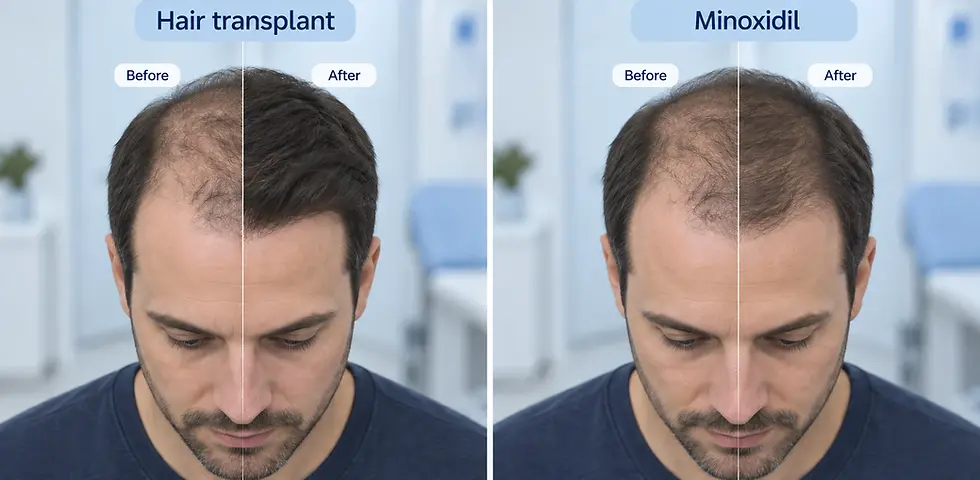
They are not really an either/or choice. Minoxidil is a daily treatment that stimulates hair growth; a hair transplant is a one-off procedure that moves your own permanent hair into thinning areas. They do different jobs.
Minoxidil works on the hair you still have. Applied to the scalp (or taken as a low-dose tablet), it stimulates follicles to grow thicker, longer hairs, and it works only while you use it: stop, and the gains are lost over the following months.
A hair transplant restores hair you have already lost. It redistributes follicles from the back and sides, which are naturally resistant to the hormone that causes pattern loss, so the moved hair is permanent, but surgery does nothing to help the untouched native hair.
Minoxidil does not treat the cause. Unlike finasteride, it does not lower the hormone (DHT) that drives genetic hair loss; it is a growth stimulant, so it props hair up rather than switching off what shrinks it. Not everyone responds, partly down to an enzyme in the scalp.
They can work together. Many people use minoxidil to support and thicken the native hair around a transplant, and it is sometimes used after surgery to help the new hair along; the transplant restores, the minoxidil maintains.
Neither suits everyone. Minoxidil suits earlier or diffuse thinning and those wanting to avoid surgery, if you accept applying it daily and a chance of scalp irritation or shedding at first. A transplant suits more established loss with a stable donor area.
If you are in the UK and considering a transplant, the sensible next step is a proper consultation and assessment, which can tell you whether medication, surgery, or a combination is right for your pattern of loss.
"Should I get a hair transplant or just use minoxidil?" is one of the first questions people weigh up when they start treating hair loss, and it is usually framed as a straight choice. In reality the two are not direct rivals: minoxidil and a transplant tackle the problem from opposite ends, and once you see what each actually does, the decision gets much clearer, and often the best answer uses both.
This guide compares a hair transplant and minoxidil neutrally: what each is, how well each works, what each costs you in time, money and effort, who each suits, and whether they can be combined. It is general information and not a substitute for personal medical advice.
The short answer
Minoxidil and a hair transplant solve two different problems. Minoxidil is a stimulator and maintainer: it pushes the follicles you still have to grow better, and holds onto hair that is thinning. A transplant is a restorer: it takes permanent hair you already own and redistributes it into areas that have gone thin or bald. One props up and thickens what is there; the other replaces what has already gone. That is why, rather than choosing between them, many people are best served using each for its separate strength.
What is minoxidil, and how does it work?
Minoxidil is a topical treatment, applied to the scalp as a solution or foam, and increasingly used as a low-dose tablet, for pattern hair loss. Unlike finasteride, it does not act on the hormones behind genetic hair loss. As a comprehensive review of minoxidil describes, it "acts through multiple pathways (vasodilator, anti-inflammatory agent, inducer of the Wnt/beta-catenin signaling pathway, an antiandrogen), and may also affect the length of the anagen and telogen phases". In plain terms it improves the blood supply and growth signals to the follicle and lengthens the active growing phase, so hairs grow thicker and longer.
One quirk matters: minoxidil is a "prodrug that is metabolized by follicular sulfotransferase to minoxidil sulfate", its active form, and "those with higher sulfotransferase activity may respond better", which is part of why some people see a good response and others little at all. Like finasteride, it is a maintenance treatment rather than a cure: the review notes hair growth peaks around the first year, and if you stop, the follicles lose the support and the gains fade over the following months, sometimes with a burst of shedding. It is applied or taken daily, indefinitely, for as long as you want the benefit. It is one of the few treatments licensed for women as well as men; our guides on minoxidil for hair loss and topical versus oral minoxidil go into the detail.
Does minoxidil regrow hair?
Yes, to a degree, and stimulating regrowth is really its main job. The review confirms that "topical minoxidil causes hair regrowth in both frontotemporal and vertex areas", and that it measurably increases hair counts over six to twelve months. It works by waking up and thickening follicles that are still present but underperforming, so thinning areas can look fuller and denser.
Two honest caveats apply. First, the regrowth is usually modest and cosmetic rather than dramatic, and it cannot bring back hair from follicles that are already gone, so it will not refill a truly bald area or rebuild a receded hairline. Second, response varies from person to person, growth tends to peak in the first year, and the benefit only lasts while you keep using it. Think of minoxidil as thickening and holding the hair you have, not replacing what you have lost.
What does a hair transplant do?
A hair transplant does not create new hair or stimulate follicles with a drug; it relocates hair you already have. Follicles are taken from the donor area at the back and sides of the scalp, which are genetically resistant to DHT, and placed into the thin or bald areas. Because those follicles keep their resistance, the transplanted hair is permanent and generally keeps growing for life. Our guide on how a hair transplant works explains the procedure, and the modern method most people have is FUE.
But a transplant only addresses hair already lost, and it does nothing to help the original, non-transplanted hair still on the scalp. That native hair is still genetically sensitive, so without something to support it, it can keep thinning around the transplanted hair over the years, which is exactly the gap minoxidil, or finasteride, can fill.
How do a transplant and minoxidil compare?
On almost every practical measure, hair transplant versus minoxidil comes down to a few clear differences. Taken point by point:
What it does: minoxidil stimulates and thickens existing hair and slows the visible thinning; a transplant replaces hair that has already gone. Stimulation versus restoration.
How it works: minoxidil boosts blood flow and growth signals to follicles that are still there; it does not treat the hormonal cause of pattern loss, so it props hair up rather than protecting it at the source.
Where it works: minoxidil works across areas that still have living, thinning follicles; a transplant fills specific bald or receded areas the surgeon places grafts into.
How permanent it is: a transplant is permanent once healed; minoxidil's benefit lasts only as long as you keep using it, and stopping can trigger shedding.
Effort: minoxidil is a daily routine, applied or taken indefinitely; a transplant is a single procedure with a recovery period and no daily upkeep afterwards.
Time to see results: minoxidil takes three to six months to show and up to a year for its peak; transplanted hair sheds first, then regrows over roughly 6 to 12 months.
Cost shape: minoxidil is a modest recurring cost for as long as you use it; a transplant is a larger one-off cost.
Main downsides: for minoxidil, the daily commitment, a variable response, and possible scalp irritation, an initial shed, or unwanted facial hair growth; for a transplant, it is surgery, with cost and recovery, and it does not help your remaining native hair.
How much hair regrowth should I expect with minoxidil versus a hair transplant?
They deliver very different kinds of regrowth, which is the heart of the comparison. With minoxidil, the realistic expectation is that thinning slows and the areas that are thinning but not yet bald become modestly fuller, as underperforming follicles are stimulated to grow thicker hair, most visibly at the crown and mid-scalp, over six to twelve months, and it varies a lot between people. What minoxidil will not do is create a new hairline or fill a bald patch, because it cannot grow hair where the follicles are gone. Think of it as thickening and holding what you have, not refilling what you have lost.
A transplant delivers the opposite kind of result: the regrowth is as much, and exactly where, the surgeon places it. A defined number of grafts, planned around your graft numbers and donor supply, are placed into the chosen area, and the great majority of transplanted follicles go on to grow, so a bald or receded area can be restored to visible density precisely where you want it. The trade-off is that a transplant redistributes a finite amount of donor hair rather than increasing your total, and it does nothing for the untouched thinning hair elsewhere.
So in short: minoxidil gives a broad, modest, growth-stimulating improvement across the areas still holding hair, while a transplant gives concentrated, reliable restoration in one defined area. For a bald hairline, only a transplant delivers; for early diffuse thinning, minoxidil alone may be enough; and combining the two often gives the fullest, most durable result. How much either can realistically achieve for you depends on your donor area and pattern of loss, which is what an assessment is for.
Which is right for you?
It depends on where you are with your hair loss. Minoxidil tends to be the better starting point if your loss is earlier or diffuse, if you want to thicken what you have and avoid surgery, and if you are willing to keep up a daily routine and see how you respond. A transplant tends to make sense once loss is more established, for a defined receded hairline or bald patch, when there is enough stable donor hair to redistribute, and often once any ongoing loss has been supported or stabilised first.
Crucially, for many people the honest answer is not one or the other. Because a transplant restores lost ground while minoxidil thickens and supports the rest, using both often gives the fullest result: the transplant rebuilds the areas already gone, and the minoxidil keeps the native hair around it looking dense. Which combination is right depends on your age, your pattern and rate of loss, and your donor area, which is exactly what a consultation is for.
Can you have a transplant and use minoxidil?
Yes, and the two are often combined. Because a transplant does nothing for the native hair around the grafts, many people continue minoxidil after surgery to keep that surrounding hair thick and to slow further thinning, so a good result is not quietly undermined over the years. Minoxidil is also sometimes used around the time of a transplant to support the recovering hair; our guide on medication after a transplant covers what may be advised.
Minoxidil is not the only option here, and it is often compared with, or used alongside, the other main medicine: our guide on hair transplant versus finasteride looks at that route, and finasteride works by lowering DHT rather than stimulating growth, so the two medicines are sometimes used together. The right mix is an individual decision best made with a clinician who knows your hair.
The bottom line
A hair transplant and minoxidil are not really competitors: minoxidil stimulates and thickens the hair you still have but must be used continuously, while a transplant permanently restores hair that has already gone but does nothing to support the rest. Which is right depends on your stage of hair loss, your goals, and your willingness to keep up a daily treatment or undergo a one-off procedure, and for many people a combination of the two gives the best and most durable outcome.
If you are in the UK and weighing up a hair transplant, the most useful step is a proper consultation and assessment with a qualified team, who can examine your donor area and pattern of loss and tell you honestly whether medication, surgery, or both is right for you, rather than deciding from a web page. It is the only way to know what will actually work for your hair.
Frequently asked questions
Is a hair transplant better than minoxidil?
Neither is simply "better"; they do different jobs. A transplant permanently restores hair that has already been lost, while minoxidil stimulates and thickens the hair you still have but must be used continuously to keep working. A transplant does nothing to help ongoing thinning of your native hair, and minoxidil cannot grow hair from follicles that are already gone. For many people the best result comes from using both, which is why a personal assessment matters more than a general ranking.
Do I still need minoxidil after a hair transplant?
Often it helps. The transplanted hair is permanent, but a transplant does nothing to support the original, non-transplanted hair around it, which can keep thinning over the years. Many people continue minoxidil, or finasteride, after surgery to keep that surrounding hair thick and slow further loss, so the overall result stays full. Whether to use minoxidil, finasteride, both, or neither is an individual decision best made with the team who assessed you.
Can minoxidil regrow a receded hairline instead of a transplant?
Usually not a truly receded hairline. Minoxidil works by stimulating follicles that are still present but underperforming, so it can thicken diffusely thinning areas, but it cannot grow hair where the follicles have already been lost, which is typically the case at a receded frontal hairline. For that, a transplant is generally the only way to restore density. Minoxidil is more useful earlier and in diffuse thinning, and a transplant for defined bald or receded areas.
Should I try minoxidil before getting a hair transplant?
It is a reasonable approach, and many clinics suggest trying medication first. Minoxidil can thicken thinning areas, may improve coverage without surgery, and shows how your hair responds before you commit to a procedure; supporting ongoing loss first can also make a transplant result more predictable. Whether to start medication, proceed to surgery, or combine them depends on your age, pattern and rate of loss, which a consultation and assessment can establish.
Minoxidil or finasteride with a hair transplant?
They work differently and are often used together. Minoxidil stimulates growth in the follicles you still have, while finasteride lowers the DHT that drives genetic loss, tackling the cause; used together they cover both angles, and either can be used to protect the native hair around a transplant. Which is suitable, and whether one or both is right for you, depends on your health and preferences and is a decision for a clinician; our guide on hair transplant versus finasteride covers the finasteride comparison in full.
Get back to Great Hair
in 3 Easy Steps:
01
Arrange Free Consultation
Speak to one of our specialist consultants for expert advice on our range of different hair loss treatments
02
Book Your Procedure
Place a deposit to reserve a time slot at one of the My Hair UK clinics across the UK
03
Attend Your Surgery
Arrive on the day and our specialist surgical team will look after your every need


What People Say About Us
Read our independent My Hair UK Reviews on Reviews.io
The Surgical Team
The surgical team is what makes the difference on the day. The clinics’ five surgeons are all GMC-registered, with a minimum of 1,000 FUE hair transplant procedures each to their name. Between them the team handles complex cases, including Afro-textured and women’s hair transplants, hairline design and lowering, and revision work.


Manchester clinic
• Dr Khawaja Masood Munir: GMC 6122581.
8+ years’ experience, 1,400+ hair transplant surgeries.
• Dr Haider Gillani: GMC 8030796.
1,000+ procedures, with specific expertise in complex cases requiring detailed anatomical understanding.
London (Harrow) clinic
• Dr Mahdi Alosert: GMC 6168297.
20+ years’ clinical experience. Specialist in Afro-Caribbean hair and hairline lowering.
• Dr Shuaib Mir: GMC 7567898.
1,200+ hair transplant cases. BAAPS plastic surgery and RCS anatomy training.
• Dr Zakar Rafiq: GMC 6164032.
MBBS and BSc (Hons) from Imperial College London. Associate Member of the International Society of Hair Restoration Surgery (ISHRS).
You can meet the surgeon who will perform your procedure at your free consultation.