Dutasteride Vs Minoxidil: How They Compare For Hair Loss
Last reviewed on 25 September 2026. We review our treatment guides every six months to keep them accurate.
Key points
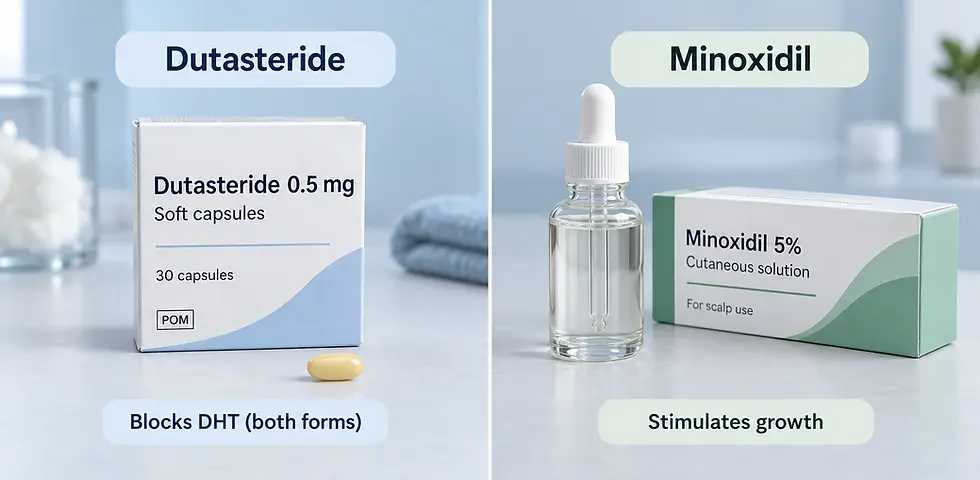
They work in completely different ways, so they are not really rivals. Dutasteride is a daily tablet that lowers DHT, the hormone that drives male pattern hair loss; minoxidil is a treatment applied to the scalp (or taken as a low-dose tablet) that stimulates the follicles to grow. One tackles the cause, the other boosts growth.
Dutasteride is the most powerful DHT blocker. It blocks both forms of the enzyme, cutting DHT by around 92 per cent, and in a head-to-head analysis it was the most effective single medicine for hair density.
Minoxidil is the mainstay topical, and works for women too. It reliably thickens and regrows hair by stimulation, and unlike dutasteride it can be used by both men and women.
They act by different routes, so they combine well. A DHT blocker plus a growth stimulant covers two angles at once and generally beats either alone, which is why the two are often used together.
Dutasteride is off-label for hair in the UK. It is licensed here for an enlarged prostate, not hair loss, so its use for hair is off-label and on a doctor’s judgement; minoxidil is a long-established, widely available hair-loss treatment.
Their downsides differ. Dutasteride carries a small risk of sexual side effects, is not for women who are or could become pregnant, and stays in the body for weeks; minoxidil can cause scalp irritation, an initial shed, and unwanted facial hair, especially in its oral form.
Neither is a cure. Both work only while used, and the benefit fades within months of stopping.
Dutasteride and minoxidil are two very different ways of treating hair loss that people often try to choose between. In fact they are not really competitors: dutasteride is the most potent of the hormone-blocking tablets, while minoxidil is the leading treatment for stimulating growth, and because they work by different mechanisms the strongest approach is frequently to use both.
This guide compares dutasteride and minoxidil neutrally: what each is, how they work, how effective they are, their side effects, who each suits, and why they are often combined. It is general information and not a substitute for advice from a doctor or pharmacist.
The short answer
Dutasteride and minoxidil attack hair loss from opposite ends. Dutasteride is a preventer: it strongly lowers DHT, the hormone that shrinks genetically sensitive follicles, treating the loss at its source. Minoxidil is a stimulator: it does not touch the hormone, but it pushes the follicles you still have to grow thicker, longer hair. Because one addresses the cause and the other boosts growth, they complement each other, and for many men the best result comes from using both rather than choosing one.
What is dutasteride, and how does it work?
Dutasteride is a once-daily tablet that lowers DHT, the hormone behind male pattern hair loss. There are two forms of the DHT-making enzyme, type I and type II; dutasteride blocks both, which is what makes it the most potent option. As a 2025 network meta-analysis describes, dutasteride "inhibits both type I and type II 5-alpha-reductase, resulting in a 92 per cent reduction in serum dihydrotestosterone (DHT)", a bigger fall than finasteride achieves. With so much less DHT reaching the follicles, the loss slows and, in many men, partly reverses. In the UK it is licensed for an enlarged prostate rather than hair loss, so using it for hair is off-label; our guide on dutasteride for hair loss explains this, and finasteride versus dutasteride compares it with the more commonly used first-line tablet.
What is minoxidil, and how does it work?
Minoxidil is applied to the scalp as a solution or foam, and is increasingly used as a low-dose tablet. Crucially, it does not act on the hormones behind hair loss. As a comprehensive review of minoxidil sets out, it "acts through multiple pathways (vasodilator, anti-inflammatory agent, inducer of the Wnt/beta-catenin signaling pathway, an antiandrogen), and may also affect the length of the anagen and telogen phases". In plain terms it improves the blood supply and growth signals to the follicle and lengthens the growing phase, and "topical minoxidil causes hair regrowth in both frontotemporal and vertex areas". It is a "prodrug that is metabolized by follicular sulfotransferase" to its active form, and "those with higher sulfotransferase activity may respond better", which is part of why some people respond well and others little. Our guides on minoxidil for hair loss and topical versus oral minoxidil go into detail.
Which is more effective for hair loss?
They are effective in different ways, and best together rather than one simply beating the other. Dutasteride is the strongest hormone-blocking option: the same network meta-analysis ranked it "the most effective option" of the medicines it compared for hair density, because blocking more of the DHT-making enzyme produces a bigger fall in DHT. Minoxidil, working by a different route, reliably thickens and regrows hair, and the review found its various forms "has comparable efficacy in the treatment of male" hair loss. Because the two mechanisms add up, combining a DHT blocker with minoxidil generally beats either on its own.
So the more useful question is usually whether to use one or both. For the strongest single treatment for male pattern loss, dutasteride is the most potent tablet (though off-label); for a woman, or someone avoiding a hormone treatment, minoxidil is the mainstay; and for the fullest result, the two are combined.
Dutasteride vs minoxidil: how do they compare?
On the measures that matter, the two differ like this:
How they work: dutasteride lowers DHT (blocking both forms of the enzyme) to treat the cause; minoxidil stimulates the follicles to grow and does not affect DHT.
Strength: dutasteride is the most potent DHT blocker, cutting DHT by around 92 per cent; minoxidil’s effect is growth stimulation rather than DHT reduction.
Form and licensing: dutasteride is an oral tablet, off-label for hair loss in the UK; minoxidil is usually a topical solution or foam (widely available) or a low-dose tablet used off-label.
Who can use it: dutasteride is for men and not for women who are or could become pregnant; minoxidil can be used by both men and women.
Effort: dutasteride is one tablet a day; topical minoxidil is applied once or twice daily and can be a little messy.
Main side effects: dutasteride carries a small risk of sexual side effects and has a long half-life, so effects clear slowly; minoxidil can cause scalp irritation, an initial shed, and unwanted facial hair, more so in the oral form (hypertrichosis in around 49 per cent of users versus about 25 per cent for topical).
Permanence: both are maintenance treatments; stopping either leads to loss of the benefit over the following months.
Which is right for you?
It depends on who you are and what you want. For a man wanting the most powerful hormone-blocking treatment and comfortable with a daily tablet, dutasteride is the strongest option, bearing in mind it is used off-label for hair. For a woman, minoxidil is usually the mainstay, since dutasteride is not suitable in women who could become pregnant. For anyone who prefers to avoid a systemic hormone treatment, or who wants to add to a DHT blocker, minoxidil is the go-to topical. And for the best result, many men use both.
Because dutasteride is a prescription medicine that strongly lowers a hormone and is off-label for hair, the choice and the monitoring belong with a doctor, who can weigh its potency against its off-label status and your circumstances. Many people also try finasteride with minoxidil first, stepping up to dutasteride only if needed.
Can you use dutasteride and minoxidil together?
Yes, and it is a logical and effective combination. Because dutasteride lowers the DHT that drives the loss while minoxidil stimulates the follicles to grow, the two work on different parts of the problem, so using them together generally gives a fuller result than either alone. A common approach is a dutasteride tablet daily plus minoxidil applied to the scalp, with the benefits adding up. What you would not do is take two DHT blockers at once: dutasteride and finasteride do the same job, so it is one or the other, combined with a different type of treatment like minoxidil.
Neither, though, can bring back hair from follicles that are already gone. Where loss is more advanced than medication can restore, a hair transplant is a separate option that redistributes your own permanent hair, and it is often combined with a DHT blocker to protect the rest; our guides on hair transplant versus finasteride and hair transplant versus minoxidil look at those comparisons.
The bottom line
Dutasteride and minoxidil are not really competitors: dutasteride is the most potent DHT-blocking tablet, treating male pattern hair loss at its source but used off-label for hair in the UK, while minoxidil is a topical (or low-dose oral) growth stimulant that thickens and regrows hair and can be used by women too. Both work only while used, and because they act by different routes they are frequently, and effectively, combined. Dutasteride is the strongest single agent for men, minoxidil is the mainstay for women and a valuable add-on, and using the two together often gives the best result.
If you are weighing them up, a doctor or pharmacist can help you decide whether to use one, the other, or both, based on your hair loss and circumstances. And if your loss is more advanced than a tablet or lotion can address, a proper assessment can set out whether a hair transplant is an option.
Frequently asked questions
Is dutasteride or minoxidil better for hair loss?
Neither is simply better; they do different jobs. Dutasteride is the most potent DHT-blocking tablet and treats the cause of male pattern loss, while minoxidil stimulates the follicles to grow and is the mainstay for women and an option for men. Because they work by different mechanisms, the most effective approach for many men is to use both together rather than choosing one. Dutasteride is also off-label for hair in the UK, so the choice depends on your sex, your hair loss and a doctor’s judgement.
Can I use dutasteride and minoxidil at the same time?
Yes, and it is a sensible combination. Dutasteride tackles the hormonal cause of hair loss while minoxidil stimulates growth, so used together they cover two angles and generally give a fuller result than either alone. A typical routine is a dutasteride tablet once a day plus minoxidil applied to the scalp. You should not, however, combine dutasteride with finasteride, as both are DHT blockers doing the same job. Check suitability with a doctor or pharmacist.
Does minoxidil work without dutasteride?
Yes. Minoxidil works on its own by stimulating the follicles to grow, and it is effective for many people, including women, who cannot take dutasteride. It will not slow the underlying loss the way a DHT blocker does, so on its own it is doing one of the two useful jobs rather than both, but it is a genuine standalone treatment. Adding a DHT blocker, where suitable, tends to improve the overall result by also treating the cause.
Which has more side effects, dutasteride or minoxidil?
They have different side effects rather than one simply having more. Dutasteride carries a small risk of sexual side effects, is not suitable in pregnancy, and stays in the body for weeks. Minoxidil can cause scalp irritation, an initial burst of shedding, and unwanted facial hair, which is more common with the oral form. Most people tolerate either well. Anyone concerned should discuss the specific risks with a doctor or pharmacist rather than being put off by the general idea of side effects.
Get back to Great Hair
in 3 Easy Steps:
01
Arrange Free Consultation
Speak to one of our specialist consultants for expert advice on our range of different hair loss treatments
02
Book Your Procedure
Place a deposit to reserve a time slot at one of the My Hair UK clinics across the UK
03
Attend Your Surgery
Arrive on the day and our specialist surgical team will look after your every need


What People Say About Us
Read our independent My Hair UK Reviews on Reviews.io
The Surgical Team
The surgical team is what makes the difference on the day. The clinics’ five surgeons are all GMC-registered, with a minimum of 1,000 FUE hair transplant procedures each to their name. Between them the team handles complex cases, including Afro-textured and women’s hair transplants, hairline design and lowering, and revision work.


Manchester clinic
• Dr Khawaja Masood Munir: GMC 6122581.
8+ years’ experience, 1,400+ hair transplant surgeries.
• Dr Haider Gillani: GMC 8030796.
1,000+ procedures, with specific expertise in complex cases requiring detailed anatomical understanding.
London (Harrow) clinic
• Dr Mahdi Alosert: GMC 6168297.
20+ years’ clinical experience. Specialist in Afro-Caribbean hair and hairline lowering.
• Dr Shuaib Mir: GMC 7567898.
1,200+ hair transplant cases. BAAPS plastic surgery and RCS anatomy training.
• Dr Zakar Rafiq: GMC 6164032.
MBBS and BSc (Hons) from Imperial College London. Associate Member of the International Society of Hair Restoration Surgery (ISHRS).
You can meet the surgeon who will perform your procedure at your free consultation.