Minoxidil Vs PRP: How They Compare For Hair Loss
Last reviewed on 29 September 2026. We review our treatment guides every six months to keep them accurate.
Key points
They aim to do a similar thing but in very different ways. Minoxidil and PRP both stimulate the follicles you still have, rather than treating the hormone (DHT) that causes male pattern loss.
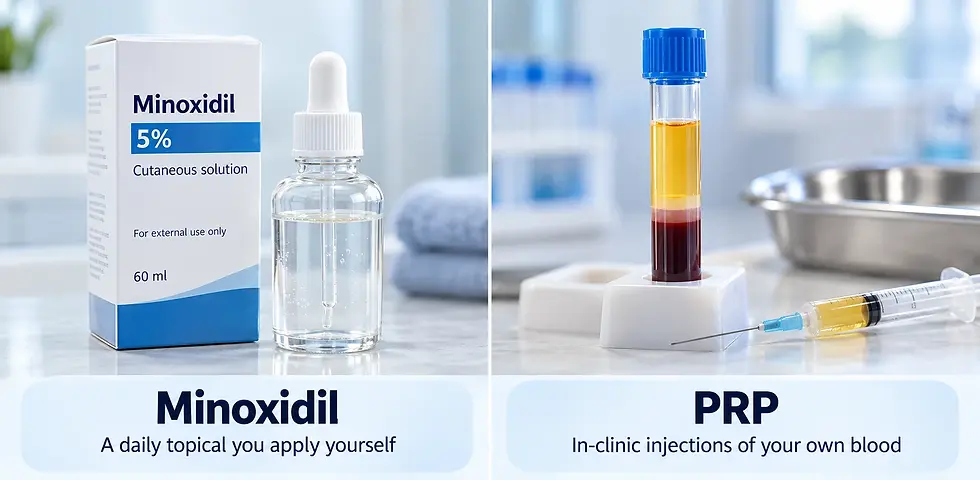
Minoxidil is a cheap, self-applied daily topical. It is a lotion or foam (also available as a tablet) that you use at home, and it is one of the most established hair-loss treatments there is.
PRP is an in-clinic procedure using your own blood. A sample of your blood is spun to concentrate the growth factors, which are injected into the scalp, so it means clinic visits rather than a home routine.
Minoxidil has the stronger, larger evidence base. It is well studied and widely used; PRP has more limited and mixed evidence, and is generally used as a supportive add-on.
Neither adds hair or restores a bald scalp, and neither lowers DHT. Both work on hair that is still there, so neither can regrow a genuinely bald area, and for that a hair transplant is the only option that adds hair.
Both are ongoing commitments. Minoxidil works only while you keep applying it, and PRP needs repeated maintenance sessions, so with either the benefit fades if you stop.
They are often combined, and the choice is really about cost, convenience and evidence. Minoxidil is cheap and self-applied; PRP is a clinic procedure that costs more. Which suits you, or whether to use both, is best decided with a clinician.
Minoxidil and PRP are both popular non-surgical options for thinning hair, and they have something important in common: both try to stimulate the follicles you still have, rather than tackling the hormonal cause of male pattern loss. Where they differ is in form. Minoxidil is a cheap treatment you apply yourself at home; PRP is a procedure done in a clinic using your own blood. Minoxidil has the larger evidence base; PRP is generally a supportive add-on.
This guide compares minoxidil and PRP neutrally: what each is, how they differ, how effective they are, what they cost you in commitment and money, who each suits, and how they fit together. It is general information and not a substitute for advice from a doctor.
The short answer
Minoxidil and PRP both stimulate the follicles you still have without addressing the hormone that causes male pattern loss, so they are close in aim but very different in practice. Minoxidil is a growth stimulant you apply yourself, a daily topical (or tablet) that is cheap, convenient and backed by a large evidence base. PRP is an in-clinic procedure that concentrates the growth factors from your own blood and injects them, with more limited evidence and the commitment of repeat sessions and higher cost. If you had to choose one, minoxidil is the cheaper, better-evidenced and easiest first step; PRP is more of a clinic add-on, for people who want to do more or cannot use minoxidil. Neither, though, can regrow a scalp that is already bald.
What is minoxidil?
Minoxidil is a topical treatment, a lotion or foam applied to the scalp (and now also available as a low-dose tablet), that stimulates the hair follicles. As a comprehensive review of minoxidil explains, it "acts through multiple pathways (vasodilator, anti-inflammatory agent, inducer of the Wnt/beta-catenin signaling pathway, an antiandrogen), and may also affect the length of the anagen and telogen phases", the phases of the hair-growth cycle. Importantly, it is "a prodrug that is metabolized by follicular sulfotransferase", and "those with higher sulfotransferase activity may respond better", which is why some people respond much better than others. The review confirms that "topical minoxidil causes hair regrowth in both frontotemporal and vertex areas". It does not lower DHT, so it stimulates the follicles without treating the hormonal cause. Our guide on minoxidil for hair loss covers it in detail.
What is PRP?
PRP, platelet-rich plasma, is a procedure rather than a product you apply. A small sample of your blood is spun in a centrifuge to concentrate the platelets, and the resulting plasma is injected into the scalp. As a review of PRP for hair loss describes, its "composition encompasses a rich variety of biological components such as platelets, growth factors, cytokines, and other bioactive proteins", and those growth factors stimulate the follicle. The evidence is encouraging but mixed: the review found that "the majority of studies demonstrated that PRP is effective in increasing hair density and thickness in patients with" androgenetic alopecia, while cautioning that "results varied due to differences in preparation protocols, platelet concentration, and delivery methods". Like minoxidil, PRP does not lower DHT, so it too supports the follicles without treating the hormonal cause. Our guide on PRP injections for hair loss explains it further.
Which is more effective for hair loss?
Minoxidil has the larger and more consistent evidence base of the two. It is one of the most studied hair-loss treatments, and the minoxidil review confirms it causes regrowth in the areas typically affected by pattern loss, though response varies from person to person. PRP has a more limited and variable evidence base: the PRP review found most studies show it can improve hair density and thickness, but stressed that results vary with how it is prepared and delivered.
The more useful point, though, is that they are close in what they do, both stimulate the follicles without treating the cause, so the choice is less about effectiveness and more about form. Minoxidil is cheap, self-applied and well proven; PRP is a clinic procedure with more limited evidence and a higher cost, and is often used to add to minoxidil rather than replace it. On its own, minoxidil is the better-evidenced and easier choice; PRP alone is a reasonable option mainly for those who cannot use minoxidil or want a clinic-based boost.
Minoxidil vs PRP: how do they compare?
The two are close in aim but differ in almost every practical way:
What they are: minoxidil is a topical lotion or foam (or a low-dose tablet) you apply yourself; PRP is a course of in-clinic injections made from your own blood.
How they work: both stimulate the follicles you still have, and neither lowers the DHT that causes male pattern loss.
Where and how: minoxidil is a daily home routine; PRP means clinic visits for an initial course and top-ups.
Evidence: minoxidil has a large, consistent evidence base; PRP has more limited and mixed evidence and is usually a supportive add-on.
Cost: minoxidil is cheap; PRP is a clinic procedure that costs considerably more over a course.
Downsides: minoxidil can cause scalp irritation and an initial shed, and response varies with your own biology; PRP involves injections and repeat visits, though it uses only your own blood.
What neither does: neither adds new hair or restores a bald area, so both are for keeping and supporting the hair you still have rather than replacing hair that is gone.
Which is right for you?
If you want the cheapest, best-evidenced and easiest option to start with, minoxidil is the obvious first step: it is inexpensive, you apply it yourself, and it is one of the most established treatments there is. PRP is a reasonable choice if you cannot tolerate minoxidil, would rather not use a daily topical, or want to add a clinic-based, drug-free boost on top of it, accepting the higher cost and the need for repeat sessions. For many, the sensible answer is not one or the other but a plan that may include both. Neither, though, suits someone whose loss is advanced or whose follicles are already gone, because both only work on hair that is still there.
Because minoxidil response varies and PRP is a clinical procedure with variable evidence, it is worth discussing either with a clinician, who can weigh up your pattern of loss, your preferences, and whether combining treatments makes sense for you.
Can they be combined with other treatments?
Yes, and minoxidil and PRP are often used together rather than as alternatives, because both stimulate the follicles and can complement each other. Neither, though, treats the hormonal cause of male pattern loss, so both are frequently paired with finasteride, the DHT-lowering tablet, which we compare with each in our guides on finasteride versus minoxidil and finasteride versus PRP. PRP also sits alongside other injectable options, covered in our guide on PRP versus PRF.
Neither can restore hair that is already gone. Where loss is more advanced, a hair transplant is a separate option that redistributes your own permanent hair, and both minoxidil and PRP are often used around a transplant to protect and support the result; our guide on hair transplant versus PRP looks at that. The key point is that minoxidil and PRP are usually part of a wider plan, not a single cure.
The bottom line
Minoxidil and PRP both stimulate the follicles you still have, and neither adds hair, restores a bald area, or lowers the hormone that causes male pattern loss. The difference is in form: minoxidil is a cheap, self-applied daily topical with a large evidence base, while PRP is an in-clinic procedure using your own blood, with more limited evidence, repeat sessions and a higher cost. Both fade if you stop, and both are best seen as part of a wider plan.
If you had to choose one, minoxidil is the cheaper, better-evidenced and easier first step, while PRP is more of a clinic add-on for those who want to do more or cannot use minoxidil. A clinician can help you decide which, or whether a combination, suits your hair loss, and how it might fit alongside other treatments or a hair transplant.
Frequently asked questions
Is minoxidil or PRP better for hair loss?
Minoxidil has the larger, more consistent evidence base and is far cheaper and easier, since you apply it yourself at home. PRP has more limited, mixed evidence and means clinic visits, so it is usually a supportive add-on rather than a first choice. They do a similar job, though, both stimulate the follicles without treating the hormonal cause, so many people use them together, and PRP alone mainly suits those who cannot use minoxidil or want a clinic-based boost.
What is the difference between minoxidil and PRP?
Minoxidil is a topical lotion or foam (or a low-dose tablet) that you apply yourself to stimulate the follicles. PRP is a procedure in which a sample of your own blood is spun and the concentrated plasma injected into the scalp to stimulate the follicles with growth factors. So they aim to do a similar thing, but minoxidil is a cheap home treatment while PRP is a clinic procedure using your own blood; neither lowers the DHT that causes male pattern loss.
Can you use minoxidil and PRP together?
Yes, and they are often combined. Because both stimulate the follicles, using them together can complement each other, and PRP is commonly added on for people already using minoxidil. Since neither treats the hormonal cause, both are also frequently paired with finasteride. Combining treatments is a decision to make with a clinician, who can advise whether it is worthwhile for your pattern of loss.
Do minoxidil or PRP regrow hair on a bald scalp?
No. Both work on follicles that are still present, stimulating them to produce fuller hair, so neither can grow hair where the follicles have already been lost. Neither will restore a genuinely bald or fully receded area; for that, a hair transplant is the only option that adds hair to bare scalp. Minoxidil and PRP are best used earlier, to keep and support the hair you still have, rather than as a cure for baldness.
Get back to Great Hair
in 3 Easy Steps:
01
Arrange Free Consultation
Speak to one of our specialist consultants for expert advice on our range of different hair loss treatments
02
Book Your Procedure
Place a deposit to reserve a time slot at one of the My Hair UK clinics across the UK
03
Attend Your Surgery
Arrive on the day and our specialist surgical team will look after your every need


What People Say About Us
Read our independent My Hair UK Reviews on Reviews.io
The Surgical Team
The surgical team is what makes the difference on the day. The clinics’ five surgeons are all GMC-registered, with a minimum of 1,000 FUE hair transplant procedures each to their name. Between them the team handles complex cases, including Afro-textured and women’s hair transplants, hairline design and lowering, and revision work.


Manchester clinic
• Dr Khawaja Masood Munir: GMC 6122581.
8+ years’ experience, 1,400+ hair transplant surgeries.
• Dr Haider Gillani: GMC 8030796.
1,000+ procedures, with specific expertise in complex cases requiring detailed anatomical understanding.
London (Harrow) clinic
• Dr Mahdi Alosert: GMC 6168297.
20+ years’ clinical experience. Specialist in Afro-Caribbean hair and hairline lowering.
• Dr Shuaib Mir: GMC 7567898.
1,200+ hair transplant cases. BAAPS plastic surgery and RCS anatomy training.
• Dr Zakar Rafiq: GMC 6164032.
MBBS and BSc (Hons) from Imperial College London. Associate Member of the International Society of Hair Restoration Surgery (ISHRS).
You can meet the surgeon who will perform your procedure at your free consultation.