When Can I Get A Haircut After A Hair Transplant?
Last reviewed on 19 July 2026. We review our treatment guides every six months to keep them accurate.
Getting a haircut after a hair transplant is one of the most common aftercare questions, and a sensible one to ask. The short answer is that a careful scissor trim comes first and clippers come much later. Clinic instructions vary, but a common pattern is a gentle trim with scissors away from the transplanted area from around two weeks, the transplanted area itself left alone for longer, and no clippers or shaver over the scalp for about two months, with one surgeon asking you to wait three before clippers go all over. Those are typical ranges rather than fixed rules, and your own surgeon's instructions come first.
For an independent overview of hair transplant recovery, the NHS hair transplant page is a good place to start. It advises being very careful with the transplanted hair for the first two weeks after the operation, because the grafts will not be secure.
One distinction runs through the whole of this guide. Your scalp now has two areas that heal differently. The donor area, at the back and sides, is where the grafts were taken from. The recipient area is where they were placed, usually towards the front and top. The donor area can normally be cut sooner. The recipient area is the one that needs protecting, and that is what makes a hair cut after a hair transplant a slightly different appointment from a normal one.
How long after a hair transplant can you get a haircut?
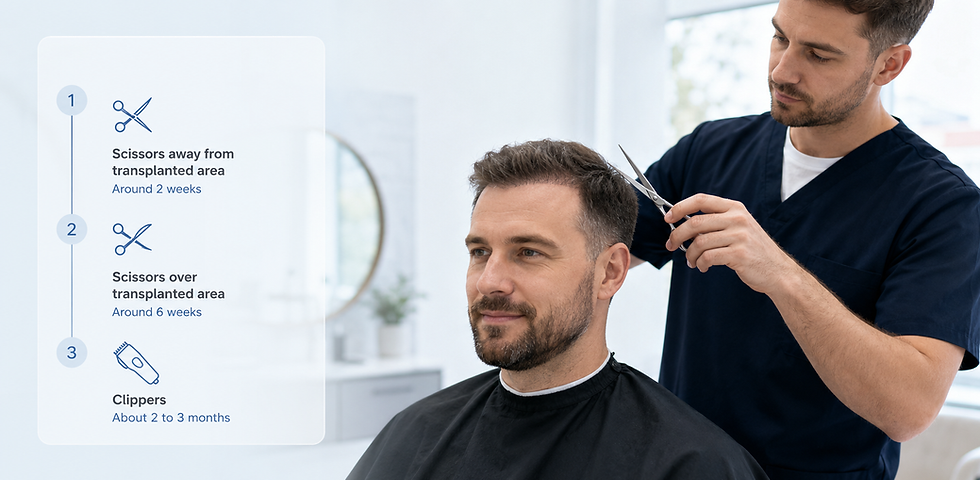
Scissors away from the transplanted area from around two weeks, over the transplanted area around six weeks, and clippers at about two to three months.
There is no single date that suits everyone, so the honest answer is a range. What matters more than the calendar is how the hair is being cut, and where on the scalp.
A gentle scissor trim, away from the transplanted area: from around two weeks. Clinic aftercare commonly allows scissors to be used gently from about fourteen days, kept to the donor area and the parts of the scalp that were not treated, with no pulling or traction on the hair.
Scissors over the transplanted area: later, often around six weeks. Some aftercare guidance asks you to leave the transplanted area itself uncut for up to about six weeks, even with scissors. If your surgeon has given you a specific date for this, use theirs.
Clippers, a shaver or a very short grade: around two to three months. This is the most consistent instruction of the three. Clinic aftercare typically says no clippers and no shaving of the scalp for about two months after surgery, and one of the surgeons asks patients to wait three months before clippers are used all over.
If you take one thing from this page, take that order: scissors before clippers, donor area before recipient area, and your own clinic's dates before any general guide.
Why the transplanted area is treated differently
In the early days the grafts sit in tiny openings in the scalp and are held in place only by healing tissue, with no blood supply of their own yet. A published review of follicular unit extraction reports that grafts become secured in the recipient site at around the sixth to ninth day after surgery, and the NHS advises being very careful with the transplanted hair for the first two weeks because the grafts will not be secure.
That is what separates the tools. Clippers and shavers press and drag across the surface of the scalp, and the comb a barber uses to lift the hair pulls on it. Scissors, working above the scalp on hair that is held lightly, do neither. It is contact and traction on new grafts that the early guidance is designed to avoid, rather than cutting as such.
The scalp is also still healing in other ways through this period. Scabs and redness are normal in the first couple of weeks, and the NHS notes that non-dissolvable stitches, if you have them, usually come out somewhere between day ten and day fourteen. If your concern is that grafts may already have come away, our guide on grafts falling out after a hair transplant covers what is and is not normal.
Can you have a buzz cut after a hair transplant?
A buzz cut is clippers over the whole scalp, avoided for two to three months, and works best once new growth is established.
A buzz cut deserves its own section, because it raises two separate questions: when it is safe, and whether it will look the way you want.
On safety, a buzz cut is the highest-risk haircut early on. It means clippers travelling over the whole scalp, including the recipient area, which is exactly what clinic aftercare asks you to avoid. The usual instruction of no clippers and no shaving for about two months, and three months in one clinic, applies to a buzz cut in full. It is not a shortcut around the timeline, it is the last thing on it.
On appearance, timing matters as much as safety. The transplanted hairs shed in the early weeks and the new growth takes months to arrive. The American Academy of Dermatology notes that transplanted hair falls out between two and eight weeks after surgery, that by the third month the area can look thinner than it did before the transplant, and that most patients see their result between six and nine months, and for some it takes twelve. Buzzing everything short during that stretch removes the length that would otherwise blend over a still-thin area, so the result can look sparser than it really is. Most people find a buzz cut works better once the new hair is properly established.
There is also the donor area to think about. The NHS says a strip (FUT) procedure leaves a scar at the back of the head that should not be visible unless you have very short hair, while FUE leaves lots of tiny scars that are not very noticeable. A published review is more cautious about FUE, noting that small pale scars of roughly 1.5 to 1.6mm are often visible in the donor area, so calling it a scarless technique is a misnomer. The American Academy of Dermatology makes the same point from the other direction: taking the hairs individually avoids the long, narrow scar, which can be an advantage if you prefer close-shaven haircuts like buzz cuts. If a buzz cut is your normal style, that is a conversation worth having with your surgeon before surgery rather than after.
What is the best haircut after a hair transplant?
There is no single best haircut after a hair transplant, and anyone naming one is guessing at your hair. There are, though, a few principles that make the growing-in months easier.
Keep a little length on top. Longer hair blends across the recipient area while the new growth is still coming through, and it is cut with scissors rather than clippers.
Avoid the shortest grades over the transplanted zone in the early months, both for graft safety and because very short hair shows a thin area rather than hiding it.
Go a little easier on the back and sides at first. If you had FUE, the donor area can look slightly uneven for a while, so a longer grade there is more forgiving than the shortest one.
Choose a style that does not need much product or hard combing. Tugging at the hair is the thing to avoid, not styling itself.
Expect to adjust as it grows. The best cut at four months and the best cut at twelve months are rarely the same one.
Colouring is a separate question with a much longer window. Clinic guidance on hair dye ranges from a few months to six, so treat it as its own decision and ask your clinic rather than adding it to an early haircut appointment.
Telling your barber
Tell your barber you have had a transplant, ask for scissors only over the transplanted area, no clippers or razor near it, and gentle combing.
This is the most useful practical step, and it is easily skipped out of self-consciousness. Modern results can be very discreet, and the American Academy of Dermatology notes they can look natural enough that a barber or stylist cannot tell anything has been done. So do not rely on your barber noticing. Tell them.
Say that you have had a hair transplant, and how many weeks ago it was.
Ask for scissors only over the transplanted area, with no clippers and no razor anywhere near it.
Ask them to comb gently and not to pull the hair taut while cutting.
Skip the vigorous wash and towel dry in the early weeks, and decline a razor finish at the neck or hairline.
If you are not confident the barber has understood, book the trim a fortnight later instead. Waiting costs nothing.
Timing a haircut around the shedding phase
People more often book a haircut for the wrong week than a dangerous one. The transplanted hairs commonly shed in the first weeks after surgery, and the NHS timeline puts new hair appearing from around four months, with the full result at ten to eighteen months. A trim booked at six weeks in the hope of tidying up new growth will usually find there is not much new growth to tidy, which is disappointing rather than harmful.
That early shedding is normal and expected, and it is not a sign the transplant has failed. Our guide on hair transplant shedding explains why the hairs fall out while the follicles stay in place, and when regrowth usually starts. If your question is really about covering up in the meantime, we also cover how long before you can wear a hat.
Frequently asked questions
When can I get a haircut after a hair transplant?
As a general guide, a gentle trim with scissors away from the transplanted area is often possible from around two weeks, the transplanted area itself is commonly left uncut for up to about six weeks, and clippers or a shaver over the scalp are usually avoided for around two months, with one surgeon asking for three before clippers go all over. Those are typical clinic ranges rather than fixed rules. Your surgeon may give you different dates, and if so, follow theirs.
Can I have a buzz cut after a hair transplant?
Not in the early weeks. A buzz cut means clippers over the whole scalp including the transplanted area, and clinic aftercare typically asks for no clippers and no shaving for about two months, and one clinic asks for three. There is a cosmetic reason to wait longer still: the transplanted hairs shed within the first couple of months and most people do not see their result until six to twelve months, so buzzing everything short before then can make the area look thinner than it will end up. Confirm the date with your own clinic.
What is the best haircut after a hair transplant?
There is no single best haircut, because it depends on your hair, your pattern of hair loss and how far into recovery you are. Through the growing-in months most people do best leaving some length on top so the hair blends over the recipient area, avoiding the shortest grades over the transplanted zone, and keeping the back and sides a touch longer than usual while the donor area settles. Scissors over the top, gentle handling, and expect to adjust the cut as the hair comes through.
Can I use clippers on the transplanted area?
Not early on. Clippers press and drag across the scalp, which is exactly the contact that new grafts need protecting from, and clinic aftercare commonly says no clippers and no shaving of the scalp for about two months, and one clinic asks for three. Scissors held above the scalp are much gentler, which is why they are allowed sooner. When clippers are safe again is a question for your own surgeon.
When can I cut the donor area?
The donor area at the back and sides is usually the first part that can be cut. Clinic aftercare commonly allows a gentle scissor trim there from about two weeks, provided the hair is not pulled or held under tension. Clippers over the donor area still fall under the general no-clippers window of around two to three months. If you had FUE, the donor area may look slightly uneven for a while, so a longer grade is often kinder than the shortest one.
Get back to Great Hair
in 3 Easy Steps:
01
Arrange Free Consultation
Speak to one of our specialist consultants for expert advice on our range of different hair loss treatments
02
Book Your Procedure
Place a deposit to reserve a time slot at one of the My Hair UK clinics across the UK
03
Attend Your Surgery
Arrive on the day and our specialist surgical team will look after your every need


What People Say About Us
Read our independent My Hair UK Reviews on Reviews.io
The Surgical Team
The surgical team is what makes the difference on the day. The clinics’ five surgeons are all GMC-registered, with a minimum of 1,000 FUE hair transplant procedures each to their name. Between them the team handles complex cases, including Afro-textured and women’s hair transplants, hairline design and lowering, and revision work.


Manchester clinic
• Dr Khawaja Masood Munir: GMC 6122581.
8+ years’ experience, 1,400+ hair transplant surgeries.
• Dr Haider Gillani: GMC 8030796.
1,000+ procedures, with specific expertise in complex cases requiring detailed anatomical understanding.
London (Harrow) clinic
• Dr Mahdi Alosert: GMC 6168297.
20+ years’ clinical experience. Specialist in Afro-Caribbean hair and hairline lowering.
• Dr Shuaib Mir: GMC 7567898.
1,200+ hair transplant cases. BAAPS plastic surgery and RCS anatomy training.
• Dr Zakar Rafiq: GMC 6164032.
MBBS and BSc (Hons) from Imperial College London. Associate Member of the International Society of Hair Restoration Surgery (ISHRS).
You can meet the surgeon who will perform your procedure at your free consultation.